A simmer pot is a simple home-fragrance method that uses water, fruit, citrus, herbs, spices or selected botanicals warmed together in a saucepan.
You may also hear it called stovetop potpourri.
The basic idea is uncomplicated:
You place aromatic ingredients in water, warm the mixture until it reaches a gentle simmer, reduce the heat and allow the fragrance to develop.
A simmer pot might contain something as simple as:
or:
or:
Apple + ginger + vanilla
or:
Different ingredients create very different scent profiles, which is why simmer pots can work in spring, summer, fall, winter and for occasions such as Thanksgiving or Christmas.
On SimmerPot.Recipes, simmer pots are treated primarily as home fragrance, not as beverages, medicines, air purifiers or therapeutic products.
Simmer Pot Meaning in Simple Terms
A simmer pot is essentially a fragrance blend warmed in water.
Think of it as a temporary aromatic mixture made from recognizable ingredients rather than a dry bowl of traditional potpourri.
The heat helps release scent from ingredients such as:
- Citrus peels
- Fresh fruit
- Herbs
- Whole spices
- Floral botanicals
- Small amounts of vanilla
The ingredients themselves are only part of the system.
Water and gentle heat are what turn those ingredients into a room-fragrance experience.
Is a Simmer Pot the Same as Stovetop Potpourri?
For most practical purposes, yes.
The phrases overlap heavily.
Simmer pot usually emphasizes the method.
Stovetop potpourri emphasizes the fragrant mixture.
For example:
“Make a simmer pot with orange and cinnamon.”
and:
“Make orange-cinnamon stovetop potpourri.”
describe essentially the same activity.
On this website, both terms can be used naturally while the page architecture keeps their intent organized.
How Does a Simmer Pot Work?
The process has four basic parts.
1. Aromatic Ingredients
Fruit, herbs and spices contain aromatic compounds.
2. Water
The ingredients sit in water so they can be warmed without simply burning against the pan.
3. Heat
Gentle heat encourages fragrance to develop and disperse.
4. Evaporation
As warm moisture and aromatic compounds move into the surrounding air, the room begins to smell like the blend.
You do not need a strong rolling boil.
A gentle simmer is usually enough.
Aromatic Profiles & Fragrance Character
That depends entirely on the combination.
A simmer pot can smell:
Fresh
Citrusy
Warm
Spicy
Woodsy
Floral
Sweet
or somewhere between several profiles.
For example:
|
Combination |
General Scent Direction |
|
Lemon + rosemary |
Fresh & herbal |
|
Lemon + lavender |
Soft floral |
|
Orange + cinnamon |
Warm citrus |
|
Apple + vanilla |
Sweet & cozy |
|
Cardamom + ginger + cinnamon |
Spiced & chai-inspired |
|
Rosemary + orange + bay |
Woodsy & green |
|
Cranberry + orange + rosemary |
Festive & fruity |
This scent-based organization is one of the main ways visitors should be able to explore SimmerPot.Recipes.
Core Botanical Ingredients
There is no single required ingredient list.
A good simmer pot usually starts with two to four aromatic ingredients rather than a crowded collection.
Useful ingredient groups include:
Citrus
- Orange
- Lemon
- Lime
- Grapefruit
Fruit
- Apple
- Pear
- Cranberries
- Peach
Herbs
- Rosemary
- Mint
- Basil
Whole Spices
- Cinnamon
- Cloves
- Cardamom
- Star anise
Other Aromatics
- Fresh ginger
- Vanilla
- Lavender
- Rose
- Chamomile
Your Simmer Pot Ingredients Encyclopedia should provide the deeper ingredient-by-ingredient reference.
A Simple Three-Part Formula
Beginners do not need a complex recipe.
Use:
1 base + 1 supporting ingredient + 1 accent
For example:
Base: Orange Support: Rosemary Accent: Ginger
Result:
Orange + rosemary + ginger
Another example:
Base: Apple Support: Orange Accent: Cinnamon
Result:
Apple + orange + cinnamon
This framework is easier to understand than trying to memorize dozens of recipes.
A Beginner-Friendly Starter Blend
A beginner-friendly combination is:
Apple, Orange & Cinnamon
Use:
- 1 apple, sliced
- ½ to 1 orange, sliced
- 2 cinnamon sticks
- About 4 cups of water for many medium saucepans
Place everything in a saucepan, add the water, warm to a gentle simmer, then reduce the heat.
Check the water regularly and add more before the level becomes low.
Scent profile: Fruity, citrusy and warm
For the detailed process, direct readers to How to Make a Simmer Pot.
Do You Need an Exact Recipe?
Not necessarily.
Recipes are helpful when you are starting, but once you understand ingredient families, you can build your own combinations.
For example, if you know that:
Lemon is bright
Rosemary is green
Ginger is warm
then:
Lemon + rosemary + ginger
is a logical fresh-herbal blend.
Likewise:
Pear is soft
Vanilla is sweet
Cardamom is aromatic
so:
Pear + vanilla + cardamom
creates a softer gourmand direction.
Why Use Whole Spices Instead of Ground Spices?
Whole spices are generally easier to manage in simmer pots.
Good examples include:
- Cinnamon sticks
- Whole cloves
- Cardamom pods
- Whole star anise
Ground spices can create sediment and may make cleanup more difficult.
They are also unnecessary when whole spices can provide plenty of fragrance.
Can You Use Citrus Peels?
Yes.
Clean citrus peels are one of the easiest ingredients to use.
Good options include:
- Orange peel
- Lemon peel
- Lime peel
- Grapefruit peel
This can be especially practical when the fruit has already been used for cooking or eating.
Avoid spoiled or moldy fruit.
Can You Use Fresh Fruit?
Yes.
Fresh fruit such as apple, pear, orange and cranberries can work well for immediate simmer pots.
Fresh fruit is different from ingredients intended for dry gift storage.
For mason-jar kits that may sit on a shelf, properly dried ingredients are more appropriate than sealing moist fresh fruit into a jar.
Can You Use Dried Ingredients?
Yes.
Dried ingredients are especially useful for:
- Simmer-pot gifts
- Mason jar kits
- Dried citrus blends
- Prepared fragrance kits
Examples include:
- Dried orange
- Dried apple
- Cinnamon sticks
- Cardamom
- Whole cloves
- Dried lavender
Fresh and dried versions may produce somewhat different results, so do not assume they are always interchangeable in exactly the same quantities.
Do You Need Special Equipment?
No special “simmer pot” is required.
For the traditional method, a normal heat-safe saucepan that is appropriate for your stovetop is usually enough.
You will also need:
- Water
- Aromatic ingredients
- A heat source
A slow cooker can also be used as an alternative method.
Can You Make a Simmer Pot in a Slow Cooker?
Yes.
Many combinations can be adapted to a slow cooker.
The main difference is that a slow cooker:
- Heats more gradually
- Behaves differently with the lid on
- May evaporate water more slowly
- Varies significantly by model and capacity
For detailed appliance instructions, send readers to the Slow Cooker & Crockpot Simmer Pot Guide.
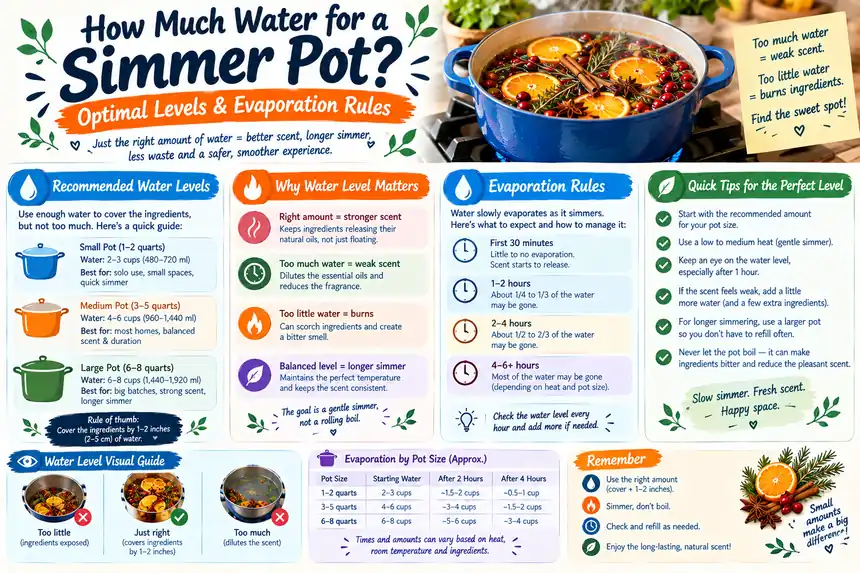
How Much Water Goes in a Simmer Pot?
For many medium saucepans, around 4 cups is a useful starting point.
But this is not a universal ratio.
The actual amount depends on:
- Pot size
- Ingredient quantity
- Surface area
- Heat level
- Simmer duration
A better rule is:
Use enough water to generously surround the ingredients while keeping the saucepan safely below the rim.
Then maintain that level throughout use.
Do the Ingredients Need to Be Completely Underwater?
Not necessarily.
Citrus slices and herbs may float.
That is normal.
The important thing is that there is plenty of water in the saucepan and that the pot does not begin drying out.
Gentle Simmering vs. Rapid Boiling
It may briefly approach boiling while you heat it, but a strong rolling boil is not necessary.
The usual method is:
Heat → reach a gentle simmer → reduce heat
A hard boil usually causes faster evaporation without offering a meaningful advantage.
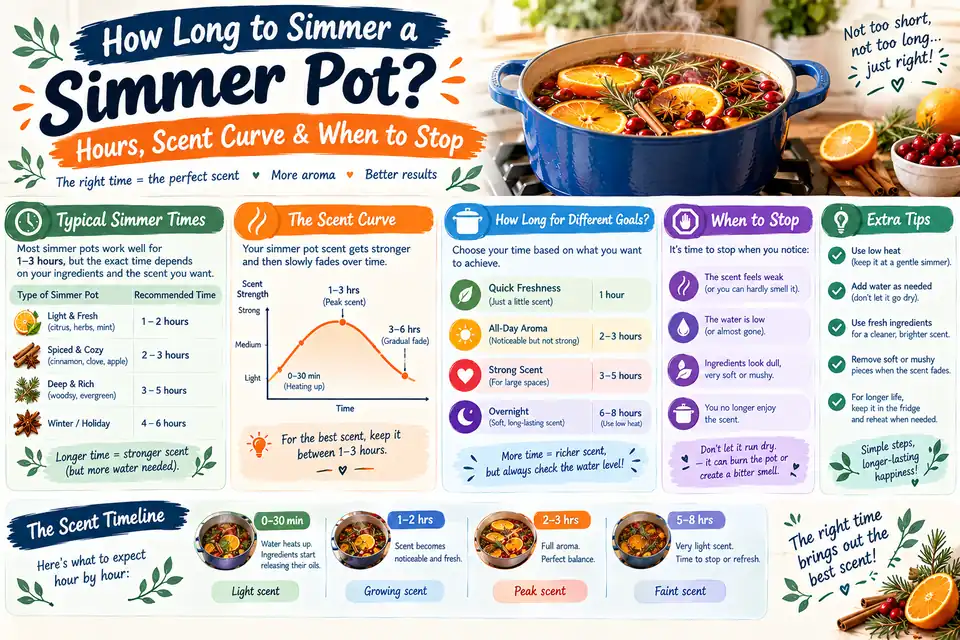
How Long Does a Simmer Pot Run?
There is no required number of hours.
A simmer pot can be used for a shorter fragrance session or for longer while you remain home and continue monitoring it.
The aroma also changes over time.
Bright citrus and delicate herbs may become noticeable earlier.
Whole spices such as cinnamon, cloves and cardamom may remain more noticeable later.
The complete timing discussion belongs in How Long to Simmer a Simmer Pot.
What Is a Scent Curve?
A simmer pot does not smell exactly the same from beginning to end.
A simplified scent curve looks like this:
Warm-up → Bright Notes → Balanced Blend → Deeper Notes → Fading
For example, a lemon-rosemary blend may smell especially citrusy early on, while rosemary becomes relatively more noticeable later.
An apple-cinnamon blend may gradually shift toward cinnamon as the fruit softens.
This is why continuously heating a simmer pot does not simply make the original fragrance stronger forever.
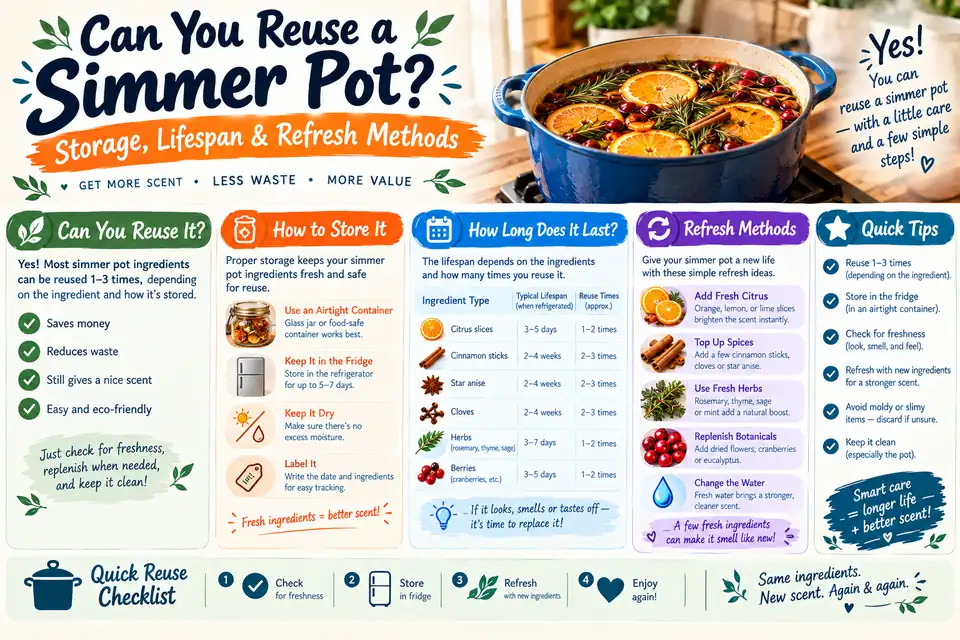
Can You Reuse a Simmer Pot?
Sometimes.
Whole spices may retain fragrance after one session.
Fruit and herbs may also remain useful for another session if the mixture was cooled and stored appropriately and still appears in good condition.
A reused blend normally becomes weaker.
For detailed next-day storage and refresh guidance, use Can You Reuse a Simmer Pot?
Primary Uses & Daily Benefits
The primary purpose is simple:
Home fragrance.
People may use simmer pots:
- During seasonal decorating
- Before guests arrive
- During fall or winter evenings
- Around Thanksgiving or Christmas
- When they want a fresh citrus-herbal scent
- As part of a housewarming or gift kit
The method does not need additional health claims to be useful.
Fragrance Diffusion vs. Air Purification
A pleasant smell does not mean the air has been purified.
SimmerPot.Recipes should not claim that simmer pots:
- Purify indoor air
- Remove toxins
- Kill germs
- Disinfect rooms
- Remove allergens
- Eliminate mold
- Detoxify the home
without appropriate evidence for a specific claim.
The accurate positioning is:
A simmer pot changes the fragrance of the indoor space.
Are Simmer Pots “Natural”?
They can use familiar fruit, herbs and spices, but “natural” is too vague to function as a safety guarantee.
A natural substance can still be:
- Irritating
- Toxic to some animals
- Inappropriate in concentrated form
- Unsuitable for a particular person
Use specific ingredient descriptions instead of implying “natural” automatically means safe.
Are Simmer Pots Safe?
The method involves hot water and a heating appliance, so safe use matters.
Basic rules include:
- Keep an active stovetop attended
- Maintain enough water
- Do not allow the saucepan to boil dry
- Keep hot cookware away from children and pets
- Keep combustible materials away from the burner
- Use proper cookware
- Use ingredients you can identify
- Turn off the heat when you cannot continue monitoring it
The dedicated Simmer Pot Safety Guide should own the deeper safety discussion.
Are Simmer Pots Safe Around Pets?
Avoid universal “pet-safe” claims.
Aromatic plant materials, concentrated essential oils and animal species can involve very different considerations.
At minimum:
- Keep pets away from hot cookware
- Do not let pets drink the simmer water
- Avoid unknown botanicals
- Do not assume whole plant ingredients and concentrated essential oils are equivalent
- Seek veterinary guidance for species-specific concerns
Should You Add Essential Oils?
They are not required.
SimmerPot.Recipes should build its main recipe system around whole identifiable ingredients such as:
- Citrus
- Fruit
- Herbs
- Whole spices
- Selected botanicals
Essential oils are highly concentrated and introduce separate handling considerations.
They should not be casually substituted for whole ingredients.
Can You Put Pine Branches in a Simmer Pot?
Avoid recommending unidentified tree clippings as a default ingredient.
Branches may be:
- Misidentified
- Treated
- Sprayed
- Preserved
- Decorative rather than suitable for heating
For a forest-inspired fragrance, use a simpler combination such as:
Rosemary + orange peel + ginger
Can You Add Flowers?
Only use botanicals you can clearly identify and that are appropriate for the intended use.
Possible ingredients include appropriately sourced:
- Lavender
- Rose
- Chamomile
Avoid:
- Unknown flowers
- Decorative florist material
- Painted botanicals
- Preserved craft flowers
- Artificial flowers
Seasonal Fragrance Directions
Spring
Think:
- Lemon
- Rosemary
- Lavender
- Mint
Good example:
Lemon + lavender
Summer
Think:
- Lemon
- Lime
- Grapefruit
- Mint
- Peach
Good example:
Lemon + lime + mint
Fall
Think:
- Apple
- Orange
- Cinnamon
- Ginger
- Cloves
Good example:
Apple + orange + cinnamon
Winter
Think:
- Pear
- Rosemary
- Vanilla
- Ginger
- Grapefruit
Good example:
Pear + vanilla + cinnamon
Christmas
Think:
- Cranberry
- Orange
- Rosemary
- Cinnamon
- Cloves
Good example:
Cranberry + orange + rosemary
Exploring by Scent Family
Another way to choose a blend is by fragrance family.
Fresh & Clean
Lemon + Rosemary
Bright Citrus
Lemon + Orange + Ginger
Warm & Cozy
Apple + Orange + Cinnamon
Spiced & Chai
Cardamom + Ginger + Cinnamon
Woodsy & Evergreen
Rosemary + Orange + Bay
Soft Floral
Lemon + Lavender
Sweet & Gourmand
Pear + Vanilla + Cardamom
This gives the website a useful discovery system that is different from seasonal browsing.
Comparison: Stovetop vs. Dry Potpourri Bowls
|
Simmer Pot |
Dry Potpourri |
|
Uses water |
Usually dry |
|
Uses heat |
Usually no heat |
|
Temporary fragrance session |
Passive fragrance |
|
Often uses fresh fruit/herbs |
Often dried materials |
|
Requires water monitoring |
No simmering required |
|
Stove or slow cooker |
Bowl or decorative container |
They share the idea of combining aromatic materials, but the methods are different.
Comparison: Simmering vs. Scented Candles
A simmer pot and candle are also very different fragrance methods.
To learn more about non-toxic whole-home fragrance, see our guide on natural ways to make your home smell good.
A simmer pot uses heated water and botanicals.
A candle uses wax, fragrance components and a flame or warming system depending on the product.
SimmerPot.Recipes should not claim simmer pots are automatically “safer,” “healthier” or “toxin-free” than candles.
Those are broad claims requiring much more context than the recipe itself provides.
Comparison: Simmering vs. Ultrasonic Diffusers
A diffuser generally disperses highly concentrated essential oils.
A simmer pot typically uses whole ingredients in water.
Those are not equivalent exposures and should not be described as though they are.
This distinction is particularly important when discussing pets and fragrance sensitivity.
Why Fragrance Follows the Seasons
Certain ingredients are strongly associated with particular times of year.
For example:
Apple + cinnamon feels autumnal.
Cranberry + orange + rosemary feels festive.
Lemon + mint feels more summery.
But there is no rule saying a particular ingredient can only be used in one season.
Orange, rosemary, ginger and vanilla can all move between several scent profiles depending on what surrounds them.
Repurposing Kitchen Peels & Spice Remnants
Some clean trimmings can be useful.
Examples include:
- Orange peels
- Lemon peels
- Apple peels
- Unused rosemary
- Citrus ends
Use ingredients while they are still in suitable condition.
A simmer pot is not a reason to use moldy or spoiled produce.
Reducing Kitchen Food Waste
They can provide another use for some appropriate kitchen trimmings, but avoid turning that into an environmental claim that every scrap should be simmered.
Some scraps are suitable.
Others may be spoiled, unsuitable or simply not aromatic.
Use judgment.
Gifting Dried & Mason Jar Kits
Yes.
Dry simmer-pot kits can be assembled with ingredients such as:
- Dried citrus
- Dried apple
- Cinnamon sticks
- Whole cloves
- Cardamom
- Dried rosemary
Keep wet fresh fruit out of shelf-style mason jar gifts.
The dedicated DIY Simmer Pot Gifts & Mason Jar Kits guide should cover packaging, dried ingredients and gift tags in depth.
Common Beginner Mistakes
Using Too Many Ingredients
Three or four aromatic ingredients are often enough.
Boiling Too Hard
A simmer is sufficient.
Starting with Too Little Water
The saucepan can dry out too quickly.
Forgetting the Water Level
Always monitor it.
Using Too Many Strong Spices
Cloves and star anise can dominate quickly.
Treating Every Botanical as Safe
Only use ingredients you can identify.
Adding Craft Decorations
Glitter, fake greenery, artificial snow and decorative items should stay out of heated cookware.
Frequently Asked Questions
What is a simmer pot in simple terms?
It is water heated with aromatic fruit, herbs, spices or botanicals to create home fragrance.
Is a simmer pot the same as stovetop potpourri?
The terms commonly describe essentially the same home-fragrance method.
What do you put in a simmer pot?
Popular options include orange, lemon, apple, rosemary, cinnamon, ginger, cloves, cardamom, vanilla and selected floral botanicals.
Do simmer pots actually work?
They can release noticeable fragrance when aromatic ingredients are gently heated in water. The strength depends on the ingredients, heat, room size and ventilation.
Do you need a special pot?
No. A suitable normal saucepan can work.
Does a simmer pot need to boil?
No. A gentle simmer is generally enough.
How much water do you use?
Around 4 cups is a useful starting point for many medium saucepans, but adjust according to the cookware and ingredients.
How long does it last?
There is no universal runtime. Use it while you can monitor the heating method and maintain the water.
Can you reuse it?
Sometimes, provided the mixture was stored appropriately and the ingredients remain in good condition.
Can you leave a simmer pot unattended?
Do not leave an active stovetop simmer pot unattended.
Is it safe around pets?
Avoid universal pet-safety claims. Keep pets away from the hot pot and prevent them from drinking the mixture.
Can you drink it?
No. SimmerPot.Recipes blends are intended for home fragrance unless a page specifically states otherwise.
What Should You Read Next?
Once a visitor understands what a simmer pot is, the next step should depend on what they want to do.
Want to make one now? Go to How to Make a Simmer Pot.
Need ingredient ideas? Browse the Simmer Pot Ingredients Encyclopedia.
Unsure about water? Read How Much Water for a Simmer Pot?
Want timing guidance? Read How Long to Simmer a Simmer Pot.
Want to save it for tomorrow? Read Can You Reuse a Simmer Pot?
Have pets or safety questions? Read the Simmer Pot Safety Guide.
Prefer a Crockpot? Use the Slow Cooker & Crockpot Simmer Pot Guide.
To experiment with custom combinations using what you already have in your kitchen, try our interactive Simmer Pot Tools Studio or search across all tested blends in the botanical recipe directory.